20 March 2025
Boramy Sou
When I first started at RUPP, it did not take me long to bump into Boramy. She was a presence in the English Language Support Unit (ELSU). She reminded me of my father-- one among few faculty members who worked long hours at the university, staying well past class time to grade and prep. She truly cares about students.
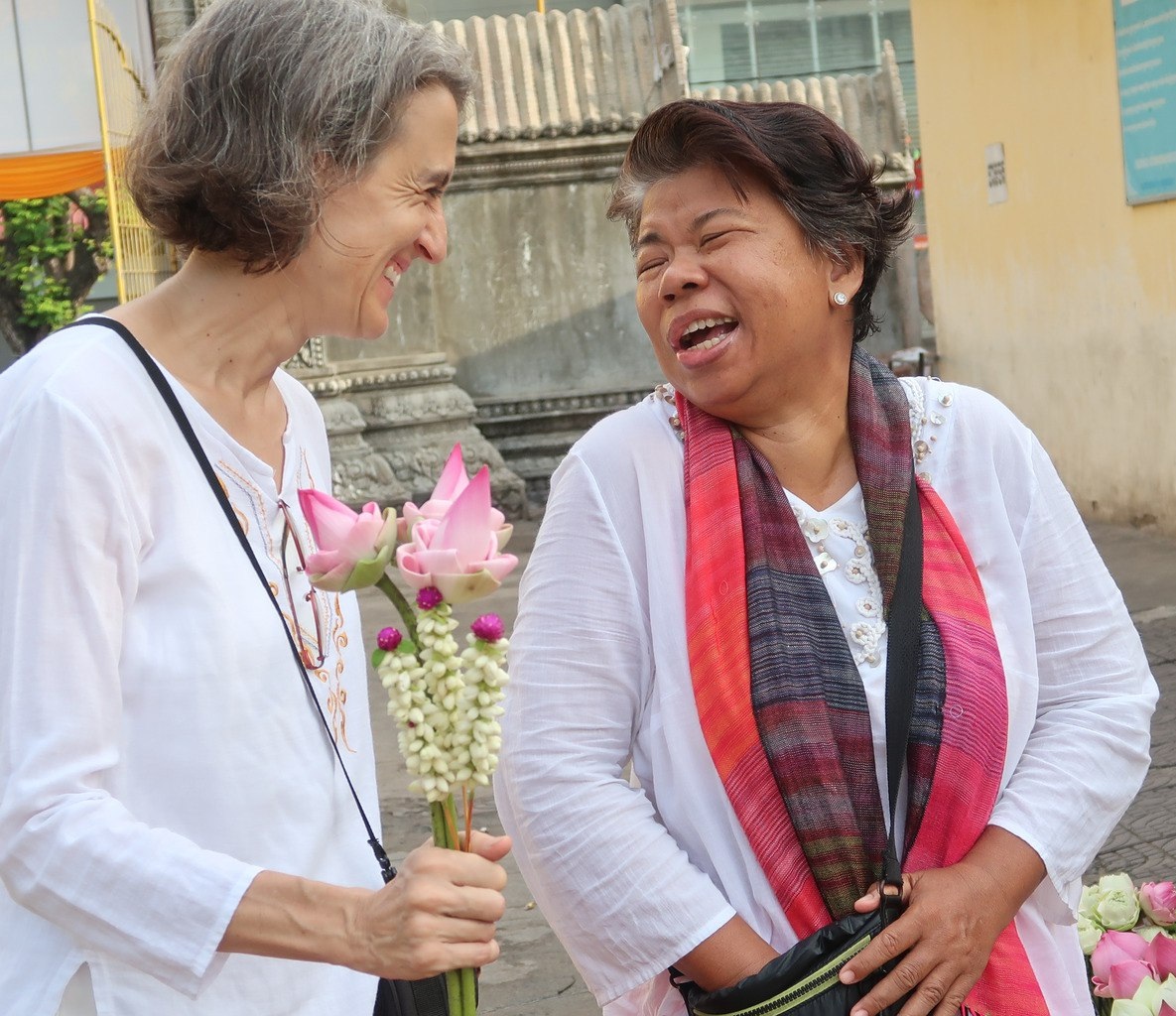
I was fortunate enough to get to know Boramy personally and she has been so kind to explain to me many of the cultural "wonders" of this "Kingdom of Wonder". In the photo, she accompanies me to the wat on Pchem Ben.
Sou Boramy is not a traditional teacher. In fact, she is not a traditional Cambodian and certainly not a traditional Cambodian woman.
At as a teacher at the Royal University of Phnom Penh (RUPP), she teaches English. But, she teaches more than language. She teaches her students to think. Certainly, her students are shy. Sometimes they resist. Most students are educated to listen, memorize, and regurgitate what the teacher had previously told them. This does not interest Ms. Sou, nor does she think it benefits students.
If you ask a former student of Ms. Sou’s how she was as a teacher, that student would likely say "tough" or "demanding". This would likely cause a smile to spread across Boramy's face. "GOOD!" she'd say.
While primary teachers are mostly female, the majority of secondary and certainly tertiary teachers are male. In that environment, Ms. Sou holds her own. She is a role model for all professors as someone who "practices what she preaches", i.e., ethical behavior as a professor and as a person.
Ms. Sou breaks many stereotypes. She rides her bicycle to RUPP. And everywhere. She is well-aware that Cambodians look down on people they perceive to be poor; she does not care. Their loss, not hers.
She travels far and wide in Cambodia's countryside and villages--by bicycle, bus, boat, etc.--taking in the country's peaceful rural spaces, ancient temples, and villages rich with people and their stories. Getting lost is an opportunity to connect with local people, something that she does well with her disarming personality.
Boramy has her finger on the pulse of the art scene in Phnom Penh. She can be seen at film festivals, music events, outdoor exhibits, etc. There she meets a host of interesting people who would otherwise be strangers.
Ms. Sou embraces relationships with foreigners. She likes to share Cambodian culture, and she appreciates the cultures of others. Having studied in Russia at a volatile time in Cambodia, she knows what it is to be in a foreigner in a foreign land. She learns and she shares wherever she can.
One of the things Ms. Sou is most proud of: her son. Alex is studying in France for a master's degree in engineering. He will likely go on for a PhD. He is not only smart, but also open-minded and has his mother's thirst for knowledge. She expects he will turn out well. With a strong, feisty mother like Ms. Sou, one thing that he'll likely not turn out to be: a traditional Cambodian man. And, depending on who you ask, that is a very good thing.
A special tribute for
Since coming to the Kingdom, I have witnessed the lives of Cambodian women - the women who faithfully walk to the wat every ស៊ុល day, the ones who serve soup from dawn to dusk, the ones who ride bicycles to the university where they've earned a scholarship, the ones whose baby they hold with one arm and tend the rice with the other, and the ones who drive their motorbikes to offices to do jobs they've fought to earn. For so many, their lives are hard, harder than most.
This is why this year I have chosen to write about a few of these women who I have been honored to know in my time here. Colleagues and friends. Students who I have been fortunate enough to keep tabs on. These are just a few stories of inspiring people. I hope you too will write your own. And maybe be an inspiration for someone else.
"Stories of Women in Cambodia" is a special project hosted within the Sharing and Listening, Cambodia 1975-1979 website, a website I created some time ago to host my students' interviews with their elders about their lives during the Khmer Rouge time.